
Why Is Everyone Religious Now?

I’ve started a Handmaids Tale rewatch. Bad decision. Don’t do it.
In a recent episode of The Daily titled ‘Why More Americans Are Seeking Religion’, Lauren Jackson, the host of Believing, a weekly series and newsletter that ‘explores modern American religion, spirituality, and culture’, talks to Asthaa Chaturvedi about why more people in the United States are now choosing to believe. Lauren grew up Mormon and then decided to leave the church after attending university. She has an intimate relationship with organised religion and faith, and gives a fascinating insight into the hard data on how the non-religious share of the US population has dropped, and the way that cultural practises, like going to a Taylor Swift concert for example, have a language of religiosity about them, that point toward a longing or want for spiritual experience.
It was a really great episode, definitely listen to it for a more robust examination than whatever this will be. But I often think of the States as being a largely religious place anyway, so I wasn’t entirely surprised that Trump’s America is seeing a resurgence in faith. What does surprise me is when I am distractedly scrolling on social media, looking for a morsel of dopamine to give me a little high, and stumble across an acquaintance, influencer, or vaguely famous British person now posting scripture, bible verses, or adding a little cross to their bio. Not much shocks me anymore, but interestingly, this does.
People need community, third spaces, ‘neighbourliness’, we’ve been saying it for years. I just thought we were trying to find ways to emulate what was good about faith, outside of organised religion? Maybe it’s because it’s the religion closest to me culturally, but it’s specifically white Christianity I find myself side-eyeing lately. This social media iteration, anyway. Not least when you see Unite The Kingdom handing out wooden crosses at their most recent march? What is that about? I’d love to know how many of them went to a church service the next day.
There weren’t too many people with very strongly held faith around me growing up. A few, sure, the usual amount. I grew up Catholic for a time. I even went to a Catholic girls school briefly, before very much not enjoying being told that the Bratz dolls I’d smuggled in in my satchel were jezebels, and subsequently moving to the local C of E primary school. I can’t remember it too much. We stopped going to church when I was still single digits, and I’d sided with my dad’s atheism over my mum’s Catholicism at quite a young age, even though so much of the Catholic way still permeates through me. Predominantly the guilt. (Maybe one of the only times I’ve ever sided with my dad on anything, one to unpick.)
A handful of friends at school were religious, but I can’t remember anyone talking about it that much, and as far as my friends go now, almost everyone is secular.
One of my best friends did quite randomly start wearing a little cross necklace and attending church for a short stint in Year 9 or 10. The memory made me laugh so I messaged her to ask why.
‘Genuinely did it because I was in my “try to be unique and kooky at whatever cost” era’, she replied. ‘Oh and also the communion breakfast group had pastries the Reverend bought in Starbucks.’
That stacks up. My own rebellion was wearing brown eyeliner in my waterline and trying to emulate Effy from Skins, so actually totally in tune with every other back-brushed-hair girl in my year.
All of this to say: I’d still be quite surprised if my friend told me they were going to church now, as I was back then. Although I have the distinct memory of feeling quite in awe of her doing this, like she must know herself better than me to be enlightened in this way. Ultimately, it was quite chic, because at the time, it felt subversive.
She did end up getting married in a church, though even that feels less common now. Godparents are still a thing, although some opt for ‘guide parents’ instead. Not too many people have christenings, and even the ones that do it feels more like a chance to celebrate and get together, than any true commitment to God.
That’s the thing isn’t it, the getting together of it all. I’ve often wondered, often out loud on my previous and current podcast, what we lost when we lost a culture of faith. The community, the neighbours, the belief in something beyond our own fleshy, capitalistic individualism. I think of how my mum sometimes talks sadly about stopping going to church; about how much of my Grandparents’ lives was spent in the community that they attended mass services with. There was a pub in Clapham South called The Plunkett where loads of the Irish Catholic diaspora congregated. It’s closed now, but I remember many happy afternoons swinging my little legs on a high-top stool, while my Grandad drank pints of Guinness and every Anne, Kathleen and Mary that walked in seemed to know me already.
So why does religion now make feel uneasy? Maybe I’m projecting my own fears onto something benign. But I also don’t think I’m imagining the pipeline, either. There’s a particular brand of hyper-visible, online Christianity that I can’t stop associating with something more sinister.
There does seem to be a route from wellness culture and self-improvement into increasingly backwards ideas about gender, sexuality and power, Steven Bartlett’s podcast feels like a good example. (We spoke about this on this episode of Everything Is Content.)
Freya India—a writer whose Substack I shared multiple times in the past, before having the rude awakening that she’s actually not a liberal young woman like me, but in fact a Conservative, traditional-values-kinda-gal—is a good example of when the rug has been pulled out from under me. We spoke about her in this episode of Everything Is Content, and recently Diabolical Lies did a forensic on her, too. I got sucked in by her ideas on social media, not realising that was the Trojan Horse with which she was disguising her more regressive opinions.
It shouldn’t really be any of my business if someone believes in God, but in this moment in time, the pursuit of religion is very much an outward facing one. It’s making reels about overcoming your history of promiscuity, finding Jesus, and ‘serving your man’. It’s confessional and instructive, ‘come to Jesus, you whore’, is sometimes I feel the pitch being offered to me by softly-spoken, modestly dressed women in their kitchens.
What I do know is that rewatching The Handmaid’s Tale while all of this bubbles away in the background feels genuinely panic-inducing. There probably hasn’t been a moment in history where The Handmaid’s Tale didn’t feel urgent, especially knowing Margaret Atwood only included things that had already happened to women historically. (Not to mention that terrible things happen to women and girls all the time now, too.) But right now, this rewatch, with Reform, Unite The Kingdom, Trump, and now this sudden influx of ‘traditional values’, makes it a waking nightmare.
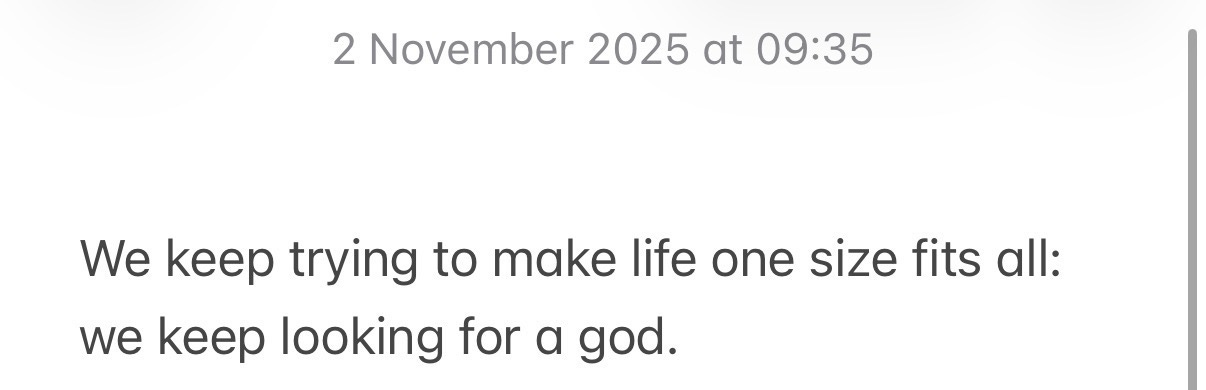
In The Daily episode, Lauren comments on the cultural obsession with astrology, fanbases, and emphasis on ‘community’. Everyone is looking for a God, for sure. It’s something I have been thinking about for a while. I think celebrities are sorts of gods to some people, influencers are prophets, we search for scripture in TikTok recommendations and Google Reviews. Lead us to the best baked goods and deliver us perfect skin, etc.
I know that everything is cyclical, that the pendulum that swings must swing back, but I always thought it was edging ever forward incrementally, two steps back out of three steps forward, sort of thing. Now it feels like a complete reversal. Perhaps that’s why books like Yesteryear feel so compelling. What if we did just go back? Would the traditional values brigade really be banging that drum if their fantasy became reality? Are they going to drag us there?
Why am I so unsettled when a prominent voice in the UK social media landscape starts talking about spiritual attacks, or an ex Love Islander says they have found God? We’re all beguiled by cult in some manner or another, whether it’s our politics, or the specific vibe of the Borough we live in, we all subscribe to ideologies that potentially blind us from other viable ways of thinking, and religion obviously has tonnes of virtues, pardon the pun.
Maybe it’s because, like the St George’s flag, it’s being co-opted by nefarious operators who’ve successfully sullied it enough in my mind to make me fear it. Maybe it’s the Russell Brand and Laurence Fox of it all, that have made religion their get out of jail free card, that makes me wary of people coming to faith later in life.
Should I just stop watching The Handmaid’s Tale?
Sent you guys a recommendation of this on the pod’s email - really think you’d love Don’t Forget We’re Here Forever by Lamorna Ash! Excellent nonfiction examining why so many people are turning to religion and she tackles all sorts of different branches of Christianity. I think online it seems that it’s predominantly quite a rightwing leaning form of the religion that is increasing its numbers but she shows the other side of the coin too. Super interesting!
Glad to read something that shared my insights too. Fortunately I listened to this podcast back in 2023 about his predictions to do with the rise of religion due to AI etc, and it mentally prepared me for what you are speaking to. It's worth a listen :)
https://open.spotify.com/episode/22QF1duMlwvws0QbMFJVLA?si=AHcOI81GSOam7BHNE69riQ