
Can't Hurt To Try
On running, writing, and potential.

Uh oh, my funky ankle that’s full of metal has started to play up, and now my beautiful house of cards is going to topple. The one I constructed to protect my wobbly mental health and partially diagnosed ADHD: a rigid scaffolding of stringent planning and routine to contain my depression-prone, distractible self.
I haven’t run since last Saturday, when towards the end of a long route, I felt an odd sensation in my lower right leg, one that I can only describe as feeling similar to having a coil put in. In both instances, a part of your body that you can’t physically touch is pinched and it’s so disconcerting that it makes you feel sick. (Fine, I could touch my cervix if I really tried, and wanted to, but I wouldn’t be able to pinch it, ok? Unless I used a pair of tweezers, I suppose.)
Turns out the hardware (that’s what they call it) that I had put in over a decade ago when I fractured my ankle in multiple places after an ill-fated box jump, has broken. One of the screws has snapped and so the two ends have shuffled into a position that means it feels like they’re jamming my insides. This is normal and fine, apparently, unless it causes pain, which in my case, it does.
Later that day, my ankle bloomed and bruised, I dutifully iced and elevated and then carried on with my weekend, because it was a bank holiday, and I couldn’t think of a worse time to go and sit in A&E. I did that the following Tuesday instead, and that’s when I got the X-ray.
Whilst on hold for over an hour and a half to be put through to Orthopaedics, with intermittent interruptions from the switchboard to tell me they were still trying, I started writing this piece. Somehow, my referral got muddled, and when I rang to ask when I might be being called, the woman on the end of the phone told me I had never been referred to the fracture clinic. She relayed this to me as I sat staring at a piece of paper showing my referral, as well as a note from my GP stating I had an appointment. I love the NHS, I really do, but the administrative side is famously a shambles. Eventually I got through, and will hopefully soon get an in-person appointment, and from there it seems likely that surgery to remove the metal in my leg is necessary. In the meantime, no running allowed.
So what now? I can make peace with a couple of months off running if it means I might have a lifetime of it ahead of me. But without it, I do worry about my brain. Thankfully there are things I can do with this injury, like spin and weights and swimming, so I can make do and hope that they will keep the monsters at bay. But it leaves me with a new problem to confront.
I’ve always found that I’m kind of okay at most things. Not a brag, it’s actually a bad thing. I could cruise through school and generally get good grades, and that came with praise and comments that I was clever from teachers, but also frustration that I wouldn’t stop talking, couldn’t concentrate and wasn’t achieving my potential.
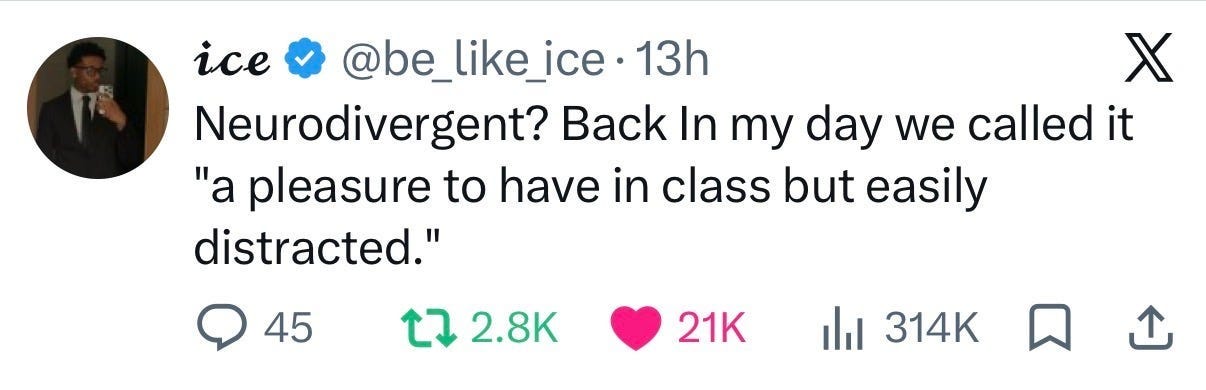
Then I wouldn’t or couldn’t put the work in for exams. I had a phobia of revision. On the one hand, I found concentrating incredibly difficult without enormous pressure, and on the other, I worried trying would reveal that actually I wasn’t that clever after all. I was only clever in relation to my lack of trying. So I found it more appealing to be able to say that I hadn’t really done any work, and then whichever way it went was either fair enough, or excellent, wow! It was the latter enough times to lull me into a false sense of security.
The thing I was never good at was sport, there wasn’t a tiny sliver of talent or natural prowess in that department, so it’s interesting that I’ve dedicated so much time to it.
I find it easy to train for a marathon, to spend hours carving out time, waking up before sunrise, reorganising my social calendar; weight training, pilates, yoga, running, circuit classes, are all part of my rotating routine of exercise and have been for over a decade now. Despite this, it still feels quite funny and novel to me how much it is a part of my personality. It turns out that showing up consistently will make you, if not exceptional, then at least pleasingly competent at something you once felt no affinity for.
But the muscle I really want to work, the thing I really want to be good at, is writing. And because of this, I find it somewhat excruciating to try. There are so many ways to be a good writer, and so many ways to be a bad one. It’s often totally subjective, and I find myself offended or somehow embarrassed when someone says they don’t like a book I like. I think people not liking films, TV shows or things you do like is universally quite a painful experience. I know this because of all the memes about it.
But with writing, I can spend hours agonising over a single sentence, then come back to it and find it frustratingly flowery. Overwriting is so enjoyable to do and just horrid to read. I read a review of Yesteryear that said the writing was undeniably appalling, and the reviewer was so sure of it that I had to go to the comments, where I found people disagreeing, and released the breath I’d unknowingly been holding. I can see how Burke’s writing might not be to everyone’s taste, but I certainly wouldn’t call it bad. In fact, I think I am quite generous in how I identify writing as ‘good’, except when it comes to my own. If a piece of writing moves me, but is grammatically abominable, I still feel that the words were worthily strung together. On the flip side, you read perfect prose and can remember the times you maybe had slogged through something that was less deft and concise. But I still wouldn’t call it bad.
Having written one book, I know how hard it is. Now working on my novel, I am impressed by anyone who writes a book, and cautious to be too critical.
I am back on a reading roll, getting through various new releases and buzzy proofs that arrive through my letterbox. The first was Famesick, Lena Dunham’s second memoir, chronic illness, meteoric rise, subsequent fall, delicious name-dropping. Then Yesteryear, Caro Claire Burke’s high-concept satire about a tradwife influencer who wakes up in the 1800s, a premise already snapped up for film by Anne Hathaway. Then Jem Calder’s I Want You To Be Happy, a searing portrait of a lopsided age-gap relationship between a cynical mid-thirties alcoholic and a doe-eyed early-twenties barista-cum-poet. Then Rosie Storey’s Dandelion Is Dead, darkly funny and bittersweet, in which a woman catfishes a man on Hinge by posing as her late sister.
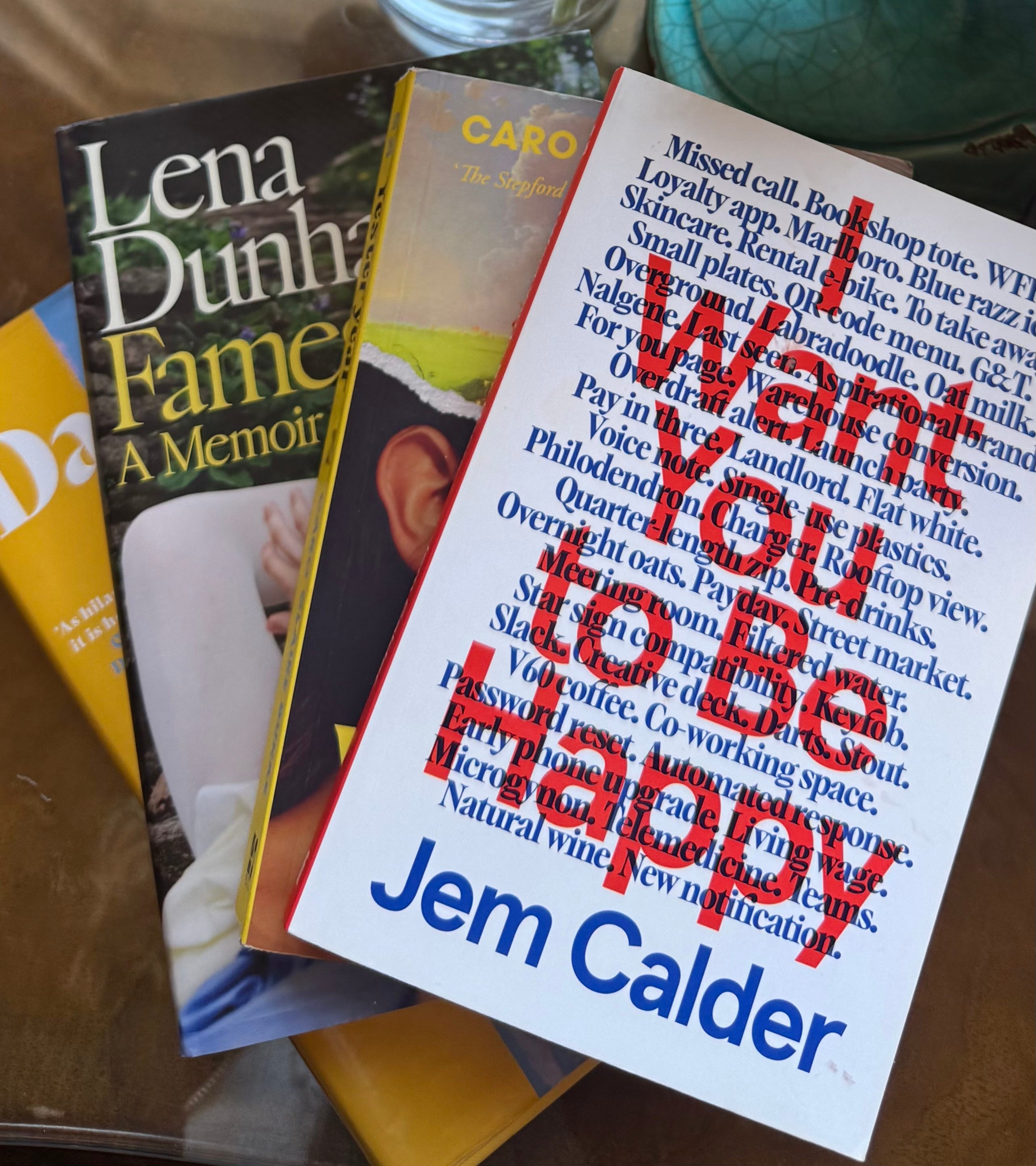
One of my biggest issues with writing, the producing of it myself, is that as a voracious reader, my appetite for good writing is big! I marvel at beautiful sentences, feel envious of writers like Calder, who really does have a touch of Sally Rooney about him. My taste greatly exceeds my ability, so I am always a failure against my own measures.
And yet, reading each of these ostensibly different books one after the other made me realise that it is now impossible to escape the internet, even in the refuge of books. So much of the plot of each took place on Instagram, over text, via email. Books as a child were often for me about escapism and adventure, whereas so often now the books I read are grounded in such hyperrealism that there is no escape, only beautifully crafted, nod-inducing extensions of the world I know too well. I think that’s why I enjoyed reading The Count Of Monte Cristo so much at the beginning of the year, the past is a fantasy all of its own.
I loved and highly recommend all of the novels I just listed, but taking them in in quick succession made me pause and realise how much despite very much not being on my phone, I hadn’t left it behind. I hate it when TV shows show text messages as bubbles, I even find email transcripts in books quite fatiguing and find myself forcing myself to read them, even though they’re formatted the same and just in the body of the book… the knowing that they’re an email makes me glaze over. I crave escape, the analog, the before… I think that is a lot of what I get from running.
I would never have applied myself so much with running if it didn’t have immediate real world benefits to my mental health. I’m so glad that it became something I’m reliant on, because it has been one of the greatest additions to my life. I guess a lot of it is that escapism, the rhythmic steps, focussed breathing and fresh air. I sometimes feel suffocated even by the idea of my phone, and it’s amazing how much more productive I can be if I switch it off and put it in another room.
Running and writing do have parallels, but where running quiets my brain and brings me into my body, a sensation I seldom experience otherwise, writing requires an internal extraction. There’s that quote that often gets misattributed to Hemingway, ‘There is nothing to writing. All you do is sit down at a typewriter and bleed.’ The problem is, in order for me to sift through my thoughts and order them in a way that’s logical to a reader, I need to feel like the outside world is still and quiet. I saw Lena Dunham talking about Famesick at the Hackney Empire with Monica Heisey, and of her writing process she said that she always writes from bed and always in the middle of the night.
For my memoir, I wrote most of that after 1am, too. But for that one I had sold it to a publisher, and so had the luxury of knowing I was getting paid. If I could stay up all night, as I used to do at uni, drinking black coffee and smoking out of my window, I’m sure I could write this novel. Only, it’s very difficult to work if you’re nocturnal. I am needed in the waking hours. Which is why I front load in the morning, and then start my other work afterwards. Often I wake at 5am and do a load of work from the minute I wake up until around 8am or 9am, when I’ll walk my dog or go for a run. The quiet of the world not having woken up, and the lack of interference from emails or messages, aids my ability to concentrate.
The work that’s truly valuable to me, the creative writing, requires such specific conditions that are ultimately frowned upon. I want to fester in my bed, with takeaway paraphernalia scattered on the floor; I want to be unwashed and somewhat manic; I want my body to become inconsequential, so that I might dive into the world in my head, undisturbed by reality.
I was supposed to be running a half marathon next Sunday. Obviously that’s off the cards, but the following day, next Monday, I have my ADHD assessment. This is actually my third time going through the process with the NHS. The first time I missed an email telling me I had an appointment, and they discarded my referral, the second time I moved just as I got to the top of the list, and they told me they couldn’t accommodate me from a different postcode, and the third time is now, when I relayed the above to the most generous GP I have spoken to, who immediately tried to pick up my previous referral. I actually forgot to mention the very first time I went to the GP about my ADHD, where he asked me what I did for work, and when I told him, he serenely answered that I didn’t have ADHD, I simply go on my phone too much. So I didn’t go back again for about a year after that.
But the signs have always been there. In fact, when I asked my mum to be my childhood informant, she rang me. Seemingly relieved she admitted that everything she had ever chastised me about as a child, or found frustrating, had all been explained by this multi-question form that she filled out, detailing all the ways that yes I had been distracted and messy and gave up on things and constantly lost things. Weirdly, this stung. She was happy to have an answer. I felt sad for little me, who could never understand why so much of what she did was so wrong. Then I remembered a conversation I had in my DMs with a woman who I know from my book club, about her ADHD diagnosis. She said it was a ‘weird sort of grief’, all of these personality traits that you fought against, only to eventually accept as just being who you are, aren’t signs of being gifted or extroverted or silly-billy-forgetful, but actually diagnosable symptoms of a condition that can be fairly debilitating within the constraints of the world that we live in.
I used to wait for my friends to all go to the library at uni so I could sit in the quiet of our house, and spend those sequestered hours focussing on my essays. In a last-ditch attempt with the first dismissive GP, I admitted that at uni we’d bought Ritalin off a friend, and whilst all my friends were laughing and saying they felt weird, I sat for hours without moving at a computer in the library and wrote an essay that got me a first. He didn’t look impressed.
Even though running has given me so much, I sometimes worry that in adapting myself to a world that favours productivity above all else, I have shaved off the creative tendrils that want to expand beyond a nine to five. That I can’t be both sound of mind and a functioning member of society, and also the creative person I used to recognise myself as when I was young.
Last year I read this Haruki Murakami piece from 2008 for The New Yorker, where the best-selling novelist writes about how running every day, no matter what, from the age of thirty-three, helped him build the endurance he needed for writing. He writes ‘Writers who are blessed with inborn talent can write easily, no matter what they do—or don’t do. Like water from a natural spring, the sentences just well up, and with little or no effort these writers can complete a work. Unfortunately, I don’t fall into that category. I have to pound away at a rock with a chisel and dig out a deep hole before I can locate the source of my creativity. Every time I begin a new novel, I have to dredge out another hole. But, as I’ve sustained this kind of life over many years, I’ve become quite efficient, both technically and physically, at opening those holes in the rock and locating new water veins. As soon as I notice one source drying up, I move on to another. If people who rely on a natural spring of talent suddenly find they’ve exhausted their source, they’re in trouble.’
It’s a really great piece and actually spurred me on with my running even more, hoping I too would find this running-writing symbiosis he spoke of. On the contrary, I found the more that I pleased the industrial work model, the less time I had to go excavating holes. But yes, I felt happier, and more sane, and more productive, but not necessarily in the areas that I wanted to.
I find it quite excruciating explaining my symptoms because a voice in the back of my head will tell me I’m actually just lazy, or incompetent, and I am so scared of those labels that I do everything in my power to appear the opposite. I have very few boundaries with my work, constantly wanting to prove myself as a hard-worker and driven. But then I will often tire myself out, too.
I actually partially stopped stand-up because I couldn’t do the unpaid late nights and exercise regularly and keep up with my other work. Lying in bed at night, I sometimes wonder how my life would look if only I could’ve dedicated the last decade to becoming vigilant with my writing. Organised my life around shutting myself away, expelling onto the page and trying to make strangers laugh in the back room of dingy pubs, instead of huffing, grunting and sweating in gyms and parks. But I know I probably would’ve got unwell, and probably extremely broke. Or maybe not. Maybe I would’ve delivered my masterpiece by now. In this economy, it is pretty impossible to be an artist. And speaking of art, I could write a whole other piece about painting. But again, it’s such a time sink, even though it’s one of my favourite things to do, it doesn’t fit neatly into the time that I find myself having.
There are so many things I want to do. Sometimes I fizz with energy and ideas, and then they all rise up at once and jam in the doorway and nothing gets out. I still flit between deciding what’s important, what I should hone, and it’s often paralysing. I am all potential and no execution.
As a teenager and young adult I forged a whole identity around some of the things which I now understand to likely be undiagnosed ADHD. Secretly, I would often find things very frustrating or embarrassing, but to peers and family I would laugh along at the fact that I hadn’t really listened, not noticing in the moment that my mind had wandered. And because I was viewed as smart, it was always assumed that I was actively deciding to rest on my laurels. I started to believe that about myself, too. It does feel a bit like grief to think that actually this could be something definable, somewhat outside of my control. As I’ve gotten older, I’ve worked hard to go against my nature, becoming organised, disciplined and regimented. I had to build a little fortress around myself, a cocoon that allows me to function in a semblance of the way I guess other, less distracted folks probably do automatically.
I have done every lifestyle trick in the book to manage my less desirable symptoms, but if one thing changes I can completely lose my way. Because of this, the reason I am desperate for a diagnosis is that I do want to try medication. At the same time, I am almost scared for it to work, because then I truly will have nowhere to hide.
What happens when I meet my potential? What if it was never actually there in the first place?
Either way, maybe medication will finally let me be both functional and creative, in the same life. Maybe I can fix my ankle and my ADHD in one fell swoop. Maybe I can be a bit more Murakami by the time I’m 33. All I’ve managed on my own is feeling like I’m losing one whilst trying to hold onto the other. Can’t hurt to try.
“What happens when I meet my potential? What if it was never actually there in the first place?” You basically described me right now. Thank you for this beautiful piece.
“I am all potential and no execution”. Woweee, hits hard. As I sit with a Substack account, year after year, with nothing published on it. Beautiful piece, thank you x